
Nikro Air Duct Cleaning in Midland: A Homeowner’s Guide
Any contractor can rent or claim to own professional equipment. What most homeowners can’t tell is whether the technician has set it up to create true negative pressure, or just switched it on and hoped for the best. Nikro air duct cleaning in Midland rests on one idea: pull debris out of your ductwork under controlled suction, never blow it loose into the rooms where your family sleeps. This guide explains how the equipment works so you can watch a job and know what you’re actually seeing.
What does “negative air” mean in duct cleaning?
Negative air means the pressure inside your ductwork is lower than the pressure in your living space. When that differential exists, air moves toward the machine instead of away from it. Loosened dust and debris travel with that air into a HEPA-filtered collection unit rather than settling onto your furniture or recirculating through your HVAC system.
Nikro builds vacuum units for exactly this job. A properly rigged Nikro machine connects to the duct system, draws air through multi-stage HEPA filtration, and holds the duct run under suction for the whole cleaning. The filter is the part that matters most. HEPA-rated media catches the fine particulate that a shop vac or a consumer blower simply pushes back into the room.
Here’s the plain version of why that matters in Midland. Homes here run their HVAC hard for much of the year, and outdoor air infiltration carries a steady load of fine dust into the return side of the system. When that dust sits in the ducts, it’s harmless until something disturbs it. High-velocity blower cleaning without containment is a fast way to redistribute months of accumulated particulate across every surface in the house. Negative air is the fix for that problem.
How is a Nikro machine actually set up?
The setup is where most jobs succeed or fail, and it happens before any brush touches a duct wall. A technician who understands the equipment follows a sequence in roughly this order:
- Find the main trunk or plenum connection point. The machine ties into the largest section of ductwork so suction reaches the whole run, not just one branch.
- Seal the registers. Every supply and return opening except the one being worked gets covered and taped so the system can hold pressure.
- Confirm the pressure differential. A technician should be able to tell you the system is pulling, whether by instrument reading or by a simple, visible check at the open register.
- Check HEPA filter condition before starting. A clogged filter can’t pull. Filters get inspected and changed when they’re loaded.
- Work one branch at a time. Each run gets agitated, extracted, then sealed back up before moving on.
If you watch a job in Midland and see registers wide open while a vacuum hums in a hallway, suction is leaking out of every opening. That’s not negative air, it’s noise. Ask the technician to walk you through the setup. A crew that knows the method will answer without hesitation.
Why does Nikro suit Midland homes in particular?
Duct runs in Midland houses can be long, especially in single-story homes with the air handler at one end and bedrooms at the other. Long runs lose static pressure, so a weak vacuum at the far register barely moves air. Nikro units are built to hold suction across distance, which is why they show up on remediation jobs where the whole system has to be pulled from one connection point.
The second factor is particulate load. Fine dust from outdoor air works its way into return ducts continuously, and in a dry climate it stays light and airborne rather than clumping. Light particulate is exactly what a HEPA-filtered negative-air unit captures best. A machine without proper filtration just moves that dust from the ducts to the room.
Abatement Technologies air filtration, which we run alongside the extraction equipment, adds another layer of containment on site. Between the Nikro vacuum holding the ducts under suction and the filtration units scrubbing the work area, particulate stays where it belongs. If the system feeds a whole-home Honeywell or Aprilaire filter setup, we clean around the filtration housing rather than through it, so the equipment keeps performing the way it was installed to.
What should you see and hear during a Nikro-equipped job?
You don’t need to know the equipment model to verify the work. You need to know what a correct job looks like in progress:
- Machine placement: the vacuum sits connected to the duct system, not parked in a hallway next to an open register.
- Sealed vents: the registers not being worked are covered, and the covers stay on until that branch is done.
- Filter condition: the technician checks the HEPA filter at the start and changes it if it’s loaded. Ask to see it.
- Sound: a working negative-air system has a steady, low pull. It should sound like suction doing a job, not a leaf blower in a closet.
- Before-and-after documentation: photos of your own ducts, taken at the same access points both times.
That last item is the one we’d point to first. Anybody can tell you your ducts are clean. Photos of your ductwork are proof. Ask for them before anyone touches a register.
How does Nikro pair with Rotobrush, and why does it need both?
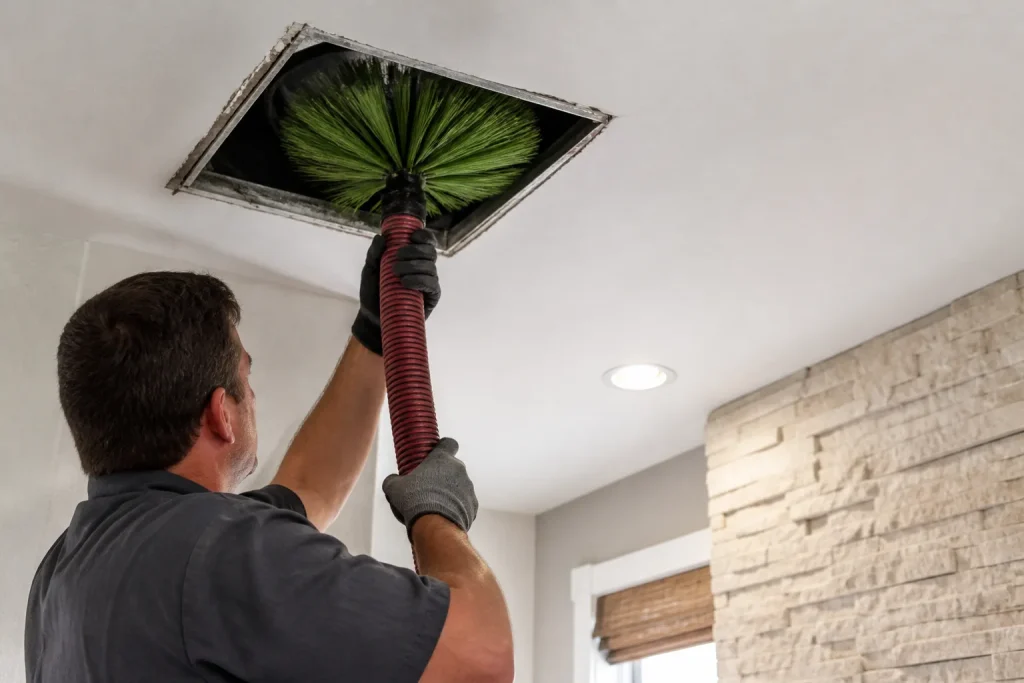
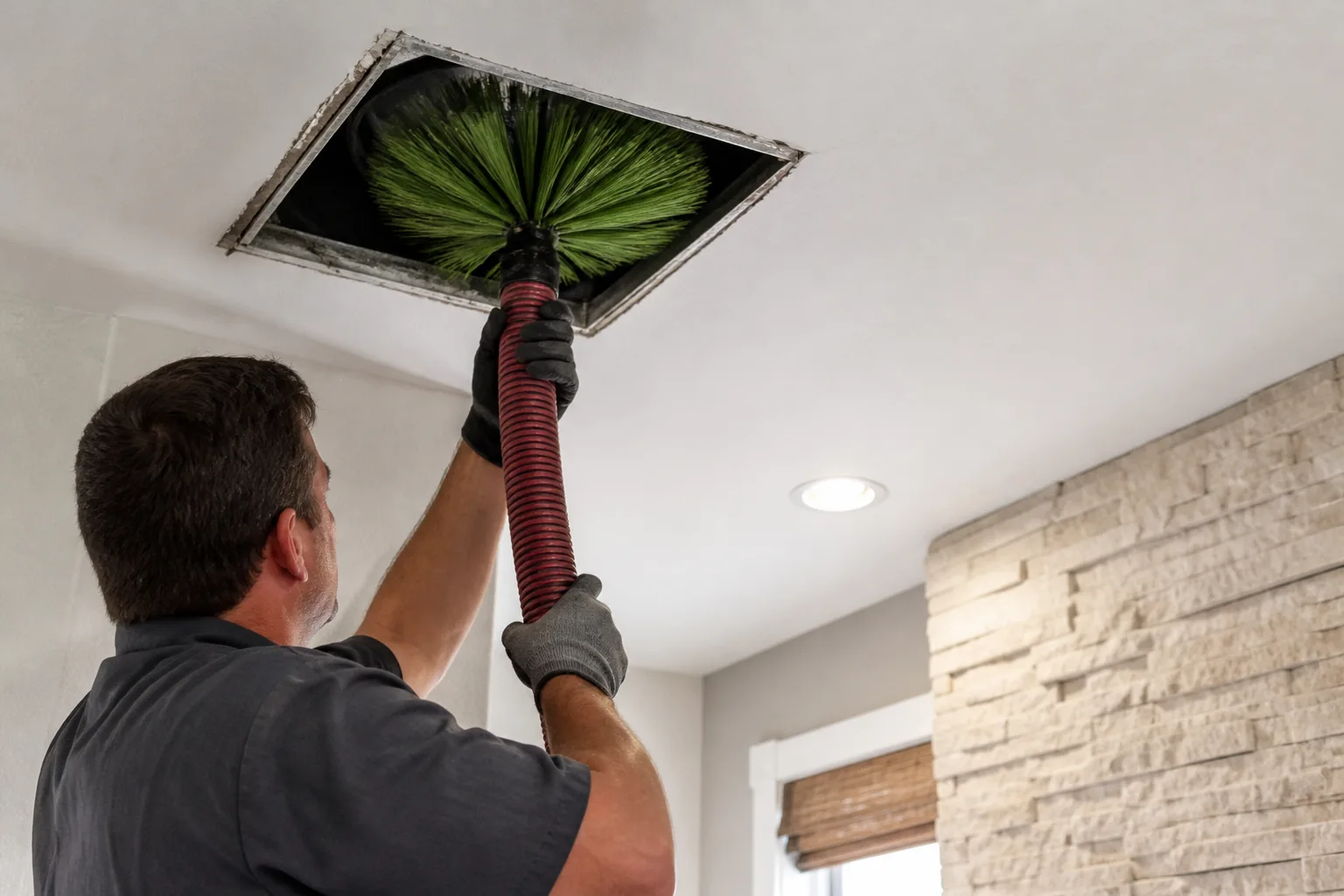
Suction alone doesn’t lift debris that’s bonded to a duct wall. Caked dust, lint, and light construction residue cling to the metal or flex liner, and air passing over them won’t break that contact. That’s what Rotobrush rotary brush systems do: a motorized brush physically scrubs the duct wall and breaks the bond. The Nikro vacuum then carries the loosened material into the HEPA filter before it can resettle.
One without the other leaves work behind. Agitation without containment redistributes debris. Containment without agitation leaves the bonded layer stuck where it was. The two-stage method, brush then extract, is what separates a real cleaning from a quick pass.
This is the same reason we treat repair as part of the job. If a brush pass reveals a separated joint, a crushed flex run, or a gap at the plenum, leaving it open defeats the cleaning. Sealing or patching the compromised section on the same visit means the system actually holds pressure the next time it runs. In a system with premium filtration hardware, a leaking duct downstream of a Honeywell or Aprilaire filter unit undermines the whole setup.
When should you call a pro instead of watching the registers?
Some signs point clearly to a job that needs professional equipment. If you see visible dust puffing from a supply register when the system kicks on, smell a musty odor that returns after cleaning your filters, or notice allergy symptoms that ease when the HVAC is off, the ductwork is the likely source. Streaks around registers and heavy dust on return grilles are the same story.
There’s also a safety side to your duct system that homeowners sometimes forget. A dryer vent clogged with lint is a fire risk, not a nuisance, and it’s a hazard no amount of furnace filter changing addresses. If you can’t remember the last time that vent was cleared, it’s overdue. These are the situations where calling in professionals beats guessing at it. Our technicians have up to 8 years of experience with this equipment, and we know what a properly pulled system looks like.
If you’re in Midland and need help, Duct Cleaning Midland offers free estimates. Call (844) 382-8255. We answer 24/7. Fast dispatch from 7am to 7pm, Sunday through Friday.
Related services in Midland: air duct cleaning, dryer vent cleaning, and duct repair for compromised runs.
The Bottom Line
Nikro equipment works because of negative pressure and HEPA filtration, and the brand name only matters if the technician sets it up correctly. Sealed registers, a checked filter, a confirmed pressure differential, and both stages (brushing, then extraction) are what separate a real cleaning from a blower pointed at an open vent. If you take one thing from this guide, make it this: ask for photos of your own ducts, before and after, and ask the technician to walk you through the setup. The good ones won’t mind at all. We sometimes think the checklist does half our job for us.
When you’re ready to have it done properly in Midland, Duct Cleaning Midland runs three services under one roof: duct cleaning, duct repair, and dryer vent work. No second contractor, no guessing. You can read more about our work in Midland and see what a clean, verified job looks like. Estimates are free. Call (844) 382-8255. We answer 24/7. Fast dispatch from 7am to 7pm, Sunday through Friday.
Frequently Asked Questions
Whole-system duct cleaning in Midland typically runs in the range a professional job with industrial-grade equipment commands, and the written estimate sets the final price. The method here is one flat price per system agreed before work starts, not a per-vent price. Call (844) 382-8255 for an exact quote. Estimates are free.
Ask the technician to show you the sealed registers and the vacuum connection, and to confirm the HEPA filter was checked before starting. You should see covers on the unworked vents and hear a steady suction. If you see open registers everywhere and a machine humming nearby, the setup isn’t right, and it’s fair to ask why. In Midland, a crew that knows the method will explain it without hesitation.
Consumer vacuums and shop vacs can’t hold a full duct system under negative pressure or filter fines the way HEPA-rated equipment does. A DIY attempt usually stirs debris into the room rather than removing it. If your ducts are visibly loading up or odors keep returning, call us at (844) 382-8255 for a free estimate.
Lowball quotes usually mean one tool, unsealed registers, and no containment. Brush-only work redistributes debris, and vacuum-only work skips the agitation that breaks bonded dust off the duct wall. The job is either done with both stages and proper negative air, or it isn’t. Call (844) 382-8255 and we’ll walk you through what ours includes before you decide.
Written by the team at Duct Cleaning Midland.
Need Air Duct Cleaning Help?
Call Duct Cleaning Midland - licensed & insured, with free written estimates in Midland.
(844) 382-8255